Plenty of serious health problems start long before anyone feels a thing. Plaque can build in the arteries, a nodule can form in the lungs, or a blood vessel can slowly widen — all while a person goes to work, exercises and feels completely normal.
That gap between feeling well and actually knowing what is happening inside the body is why more people are asking about full body CT scans. Below is a plain-language look at what this kind of imaging examines, what it may reveal, and where its limits are.
At a Glance
- A full body CT scan produces detailed images of organs, blood vessels, bones and soft tissue.
- Findings can point to heart disease, lung disease, aneurysms, tumors and other conditions.
- Imaging can show that something abnormal is there, but it can't always tell whether a finding is cancer — follow-up testing may be needed.
- At Advanced Body Scan, the full body exam covers the neck through the pelvis and does not include the brain.
- The CT portion itself takes under five minutes.
- A scan adds information; it does not replace a physician or other age- and risk-appropriate screenings.
How CT Imaging Works
Computed tomography (CT) captures a series of cross-sectional images — often described as "slices" — of the inside of the body. Rather than a single flat picture like a standard X-ray, those slices can be reviewed one at a time or reconstructed into a three-dimensional view.
According to the American Cancer Society, CT shows bones, organs and soft tissue in more detail than an ordinary X-ray, and it can help physicians judge the size, shape and position of an abnormal mass relative to nearby structures.
In a preventive setting, the goal shifts. Instead of asking "what is causing my symptoms?", the question becomes "what is there that I can't feel yet?" You can read more about the equipment used for this kind of imaging on the Advanced Body Scan technology page.
Which Areas Are Examined?
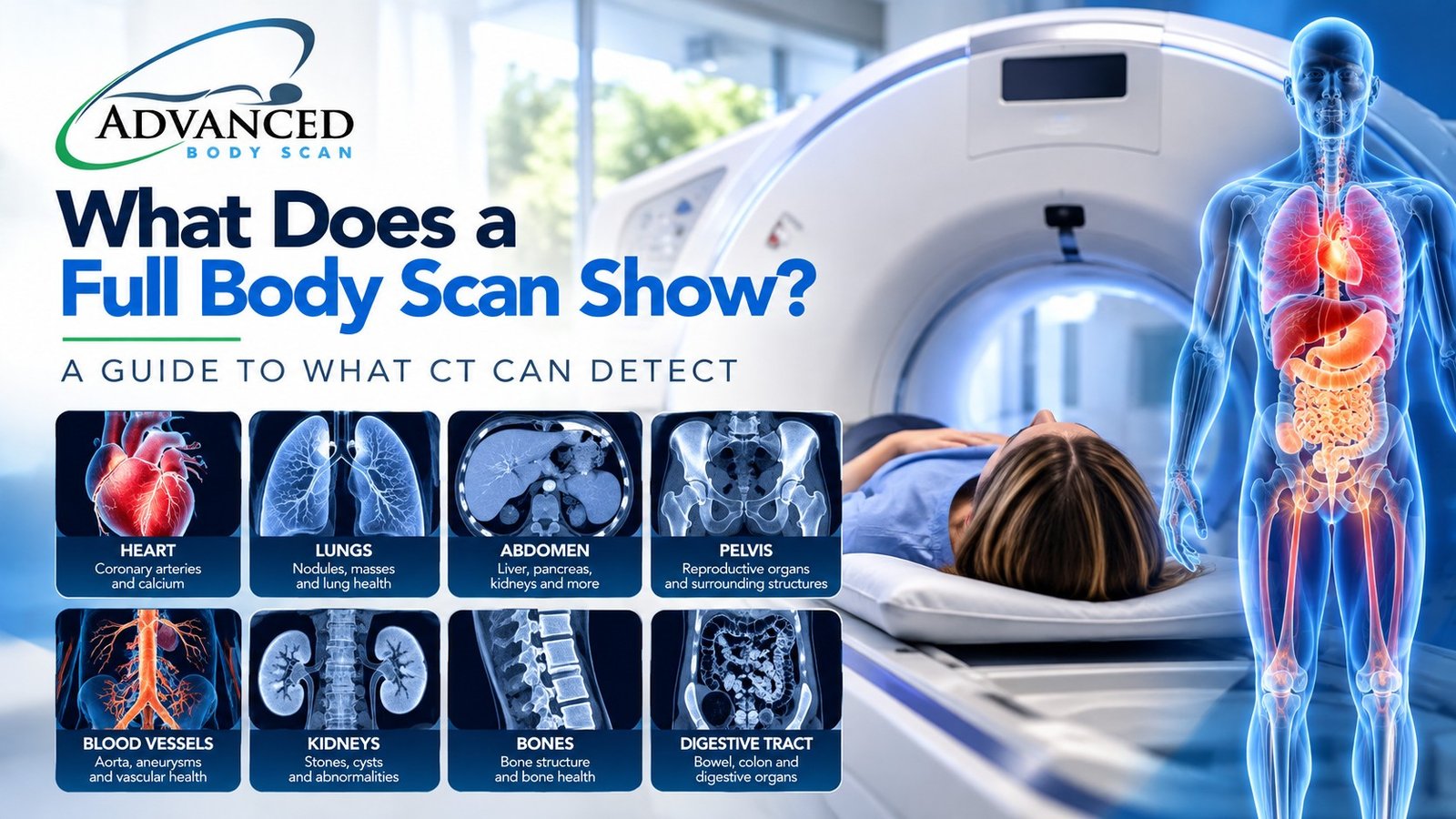
The full body CT exam offered by Advanced Body Scan reviews the region from the neck down through the pelvis — more than 22 organ systems in all. Within that range, physicians can evaluate:
- The heart and coronary arteries
- The lungs
- The aorta and other major blood vessels
- The liver, pancreas, gallbladder and spleen
- The kidneys and adrenal glands
- The bowel and pelvic organs
- Bones and soft tissue
The advantage is breadth: many systems can be reviewed together in one visit rather than one organ at a time. Details on what's included are listed on the full body scan page.
Heart Disease
Heart disease is the leading cause of death in the United States, and it often develops without obvious warning. CT can detect calcium deposits in the coronary arteries — a marker of atherosclerosis that helps estimate cardiovascular risk. Cardiac CT can also show the heart chambers, valves, coronary arteries and aorta in detail.
For someone who feels healthy, that kind of information can be the first sign that a conversation with a physician about heart risk is worthwhile. Advanced Body Scan offers a dedicated heart scan for people focused specifically on cardiovascular risk.
The Lungs
CT is especially well suited to examining lung tissue. It may reveal:
- Nodules or masses
- Scarring
- Emphysema-related changes
- Other structural abnormalities
It's worth stressing that lung nodules are common and many are benign. What matters is knowing a finding exists, so a physician can decide whether to watch it, compare it with future imaging or order more tests. More on lung imaging is available on the lung scan page.
Cancer: What Imaging Can and Can't Do
CT can uncover masses, lesions and nodules that may represent cancer, sometimes before symptoms begin. But an image alone cannot always confirm a cancer diagnosis. Some suspicious findings turn out to be harmless, and a biopsy or other testing is often needed to know for certain.
The point of early detection isn't to turn every unusual spot into a scary diagnosis. It's to surface findings that deserve a closer look, so the next step can be decided with a physician.
Aortic Aneurysms
The aorta is the body's largest artery. An aneurysm forms when part of its wall weakens and bulges, and some aneurysms grow without causing noticeable symptoms. Because CT images the aorta clearly, an unexpected enlargement can be identified and passed along for appropriate medical follow-up. This is a good illustration of preventive imaging: sometimes the most important finding is one nobody knew to look for.
Other Possible Findings
Not every result relates to the heart or cancer. Depending on the person, a scan may show:
- Kidney stones or gallstones
- Liver lesions
- Pancreatic or adrenal abnormalities
- Diverticular disease
- Hernias
- Bone abnormalities
- Soft tissue masses or enlarged lymph nodes
Some of these are minor; others warrant further evaluation. Either way, they are pieces of information that weren't available before.
What a Body Scan Doesn't Replace
No single test answers every health question. A full body CT scan is not a substitute for:
- A primary care physician and routine bloodwork
- Mammograms and cervical cancer screening when appropriate
- Colonoscopy or other recommended colorectal testing
- Skin exams
- Evaluation of new symptoms
- Testing recommended because of personal or family history
It helps to think of imaging as one more layer. Lab work, family history and a physical exam each tell part of the story; imaging shows internal structures none of those can see directly. Together, they provide context.
How Long Does It Take?
Many first-time patients are surprised by the speed. At Advanced Body Scan, the CT scan itself takes less than five minutes, and most visits last around 20 minutes including check-in. The company has focused on early detection for more than two decades, with centers serving Oklahoma City, Dallas/Plano and Houston/Bellaire.
Who Tends to Look Into Full Body Scans?
There's no single profile, but people commonly start researching after:
- A family history of heart disease or cancer
- Current or past smoking
- Known cardiovascular risk factors
- Reaching an age when health risks climb
- Watching a loved one receive an unexpected diagnosis
- Wanting baseline images to compare against in the future
Age, history and individual risk all matter, which is why a consultation is a sensible first step. Common questions about the process are answered on the Advanced Body Scan FAQ.
The Bottom Line
Most people seek care after something hurts. Preventive imaging flips that order: it looks first. A scan can't predict the future or guarantee that every disease will be found, but it can provide a detailed snapshot of the body today. Sometimes the result is reassurance, sometimes it's something to monitor, and occasionally it's a finding that needs prompt attention. All three outcomes start with information.
Frequently Asked Questions
What does a full body CT scan look at?
It images the heart, lungs, major blood vessels, abdominal and pelvic organs, bones and soft tissue, and may identify coronary calcium, lung nodules, aneurysms, masses, kidney stones and more.
Can a full body scan find cancer?
It can find masses, lesions or nodules that may be suspicious for cancer. Confirming a diagnosis usually requires additional testing.
Does it include the brain?
Not at Advanced Body Scan. The full body exam stops at the neck; brain imaging is offered separately.
Can it replace an annual physical?
No. A scan complements your physician, lab work and other recommended screenings rather than replacing them.
More information
Want to learn more about preventive scans? Go here for more info.
Scan options, pricing, locations and answers to common questions are available from Advanced Body Scan.
Visit AdvancedBodyScan.com →