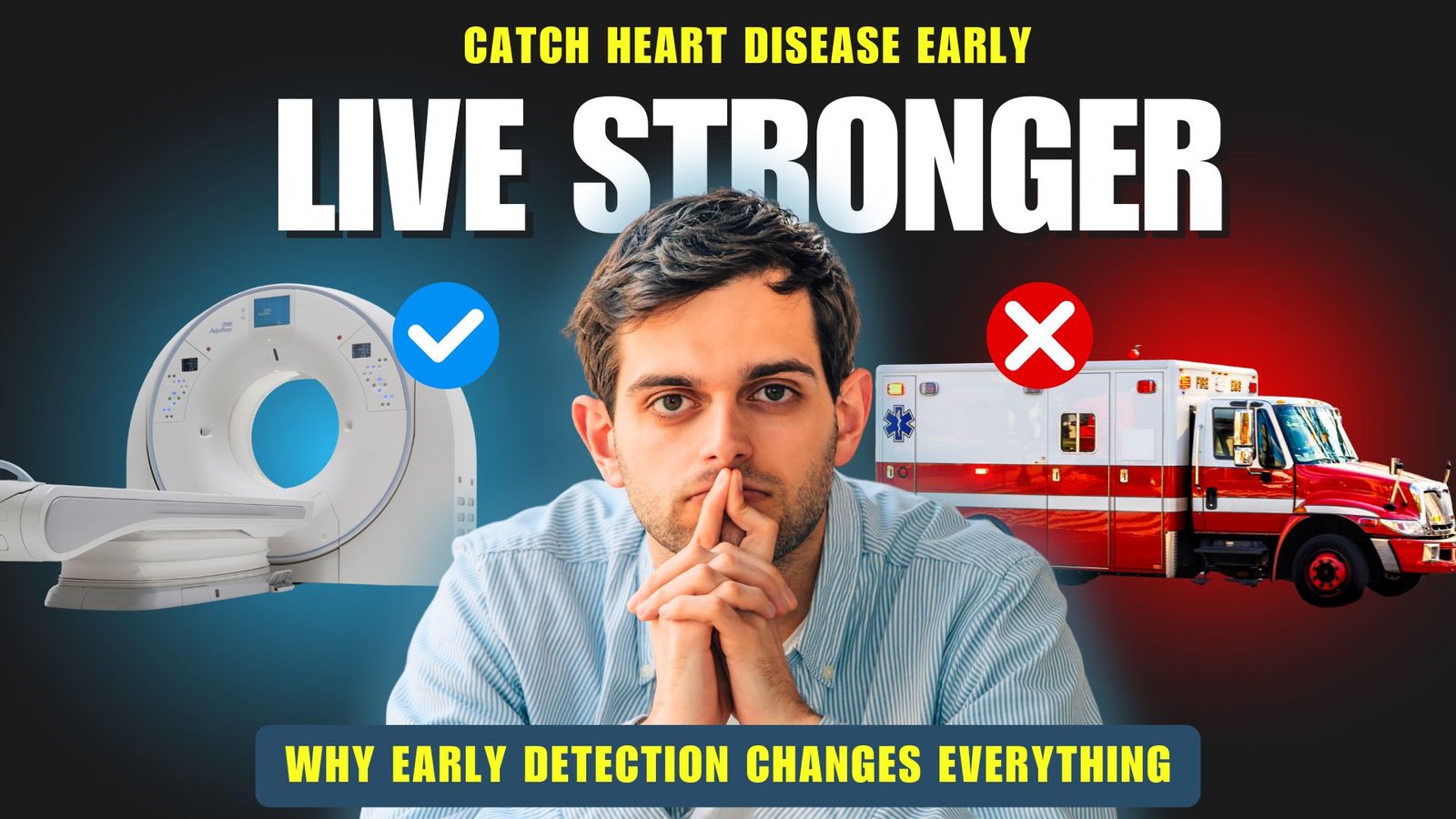
Heart disease remains the leading cause of death in the United States, and the CDC notes that someone dies from cardiovascular disease roughly every 33 seconds. Yet the disease usually builds slowly. Plaque in the coronary arteries — atherosclerosis — can grow for years without symptoms.
This article explains why early visibility matters, how calcium scoring works, and what people can do with the information.
Key Points
- Many heart attacks are "silent," producing few or no classic symptoms.
- A CT heart scan with calcium scoring reveals plaque early and improves risk prediction beyond standard calculators.
- CT is well suited to imaging both the heart and the lungs, and the scan takes under five minutes.
- Routine checkups identify risk factors; imaging can identify the disease itself.
Silent Heart Attacks Are More Common Than People Think
The American Heart Association estimates that about 170,000 of the roughly 805,000 heart attacks in the U.S. each year are silent. Reviews have put the share of unrecognized heart attacks anywhere from about one-fifth to nearly half, and these events still raise the risk of future heart attacks and heart failure. That's why "I felt a little off, but not in pain" is such a familiar story.
What Early Detection Looks Like
Seeing plaque before it causes problems
A coronary artery calcium (CAC) score is one of the most reliable ways to visualize calcified plaque. Large population studies published in AHA journals show that 10-year risk of coronary heart disease rises as calcium scores rise, and that CAC adds predictive value beyond age, cholesterol, blood pressure, diabetes and smoking. A 2023 analysis in JAMA similarly found CAC improved risk discrimination when added to traditional measures.
In practice, an elevated score gives patients and clinicians reason to pursue lifestyle changes and, where appropriate, medication more aggressively. A score of zero can reframe risk and help personalize a plan. Either way, the result brings clarity. The heart scan page explains how the test is performed.
Why CT Is Used for Early Cardiac Imaging
When the goal is to see the coronary arteries and the lungs clearly, CT is the tool built for the job. MRI has many strengths, but it isn't the first choice for measuring coronary calcium or screening the lungs. Lung cancer is the leading cause of cancer death in the U.S., accounting for about one in five cancer deaths, according to the American Cancer Society — so imaging that covers both organs addresses the two biggest threats.
At Advanced Body Scan, the CT scan typically takes under five minutes, with no needles and no clothing change. That simplicity makes it easier to repeat over time and track trends.
Who Considers a Heart Scan?
Advanced Body Scan suggests heart scans for adults 30 and up, especially those with:
- A family history of early heart disease
- High blood pressure, high cholesterol, diabetes or prediabetes
- Current or past smoking
- High stress, poor sleep or a sedentary lifestyle
- Excess weight, particularly around the midsection
What the Results Offer
An objective risk signal
A calcium score is a number that stratifies risk, and research shows it significantly sharpens prediction when added to standard calculators.
A clearer plan
- Zero or very low score: keep up healthy habits and rescan at intervals.
- Moderate to high score: tighten lifestyle factors and discuss therapies with a clinician. Diet, exercise, sleep and medication together can change the trajectory.
Motivation
Seeing images of one's own arteries tends to make risk feel real, and patients often become more consistent with lifestyle changes and medications afterward.
A look at the lungs
Because CT images the lungs well, it can also reveal early signs of lung disease. For people who want both, the HeartIQ scan and full body options are worth comparing.
Common Questions
"I already get annual checkups."
Keep them. But routine visits and bloodwork can't see coronary plaque. Checkups identify risk factors; imaging identifies disease. The two work best together.
"Will results go on my insurance record?"
Advanced Body Scan keeps results private, and patients control who sees their images and report.
"What is the scan like?"
Quick and comfortable — no needles and no enclosed tube. If significant findings appear, a specialist reaches out to explain next steps.
The Cost of Not Knowing
The CDC estimates cardiovascular disease costs the U.S. hundreds of billions of dollars a year in care, medications and lost productivity. Early detection paired with targeted prevention is one of the most practical ways to reduce that burden — for families and for individuals. Centers are in Oklahoma City, Dallas/Plano and Houston/Bellaire; see locations.
Sources
- Centers for Disease Control and Prevention: leading causes of death and cardiovascular disease statistics.
- American Heart Association: silent heart attacks are common and often overlooked.
- Mehta A, et al. Circulation: Cardiovascular Imaging, 2020 — CAC categories and coronary heart disease risk.
- Khan SS, et al. JAMA, 2023 — CAC and risk discrimination beyond traditional factors.
- American Cancer Society: lung cancer key statistics.
More information
Want to learn more about preventive scans? Go here for more info.
Scan options, pricing, locations and answers to common questions are available from Advanced Body Scan.
Visit AdvancedBodyScan.com →